


In this series, I dig a little deeper into the meaning of psychology-related terms. This week’s term is self-esteem.
Self-esteem refers to the extent to which we perceive the various elements of our self-concept positively. It incorporates our physical self-image, how we feel about the things we’ve accomplished, how successful we consider ourselves to be at the things that are important to us, and how we feel about how others view and interact with us. It’s not something you simply have or you don’t; rather, it’s a subjective appraisal of all of those various elements. It’s not necessarily stable over time, and it’s something we have the power to change.
A commonly used measurement tool is the Rosenberg Self-Esteem Scale.
Related constructs
There are various psychological constructs that are similar but distinct. Understanding what self-esteem is not can make it clearer what it is. Some of these related concepts include:
- self-acceptance: understanding one’s self, including strengths and weaknesses, and accepting the whole package, warts and all
- self-compassion: this is about how we treat ourselves, and recognizing that we are fallible humans that are deserving of kindness and forgiveness simply by virtue of being human; a positive view of the self can make it easier to practice self-compassion, but isn’t necessary
- self-concept: the perception of who you are, and what makes you, you
- self-confidence: our belief in our ability to handle ourselves in the situations we find ourselves in, including problem-solving and dealing with challenges that arise
- self-doubt: feelings of uncertainty about some aspects of the self; some extent of self-doubt is very normal and can help to keep us realistic, and it can co-exist alongside self-esteem
- self-efficacy: this is more specific than self-confidence, and is a sense of being able to get ‘er done when it comes to particular types of tasks
- self-image: this is sort of like the judgy form of self-concept, and often, it isn’t very well grounded in reality
- self-love: an authentic appreciation of the self that’s more enduring than self-compassion, which can be practiced in how we treat ourselves at particular points in time; a deficit of self-love can contribute to poor boundaries and codependency
- self-importance: rating one’s own importance/value as higher than others; someone can view themselves positively without seeing themselves as being above others, but someone can also have very high self-importance that’s underpinned by a negative appraisal of the self
- self-worth: this is similar to self-esteem, in that it relates to how we value ourselves, but it takes a bigger picture perspective, seeing ourselves as valuable, worthy human beings in the world
Contributing factors
Childhood factors, including home environment, poverty, and lack of praise, affection and encouragement, can have a big impact. Failing to meet the expectations of others, including family and peer groups, can also contribute to low self-esteem.
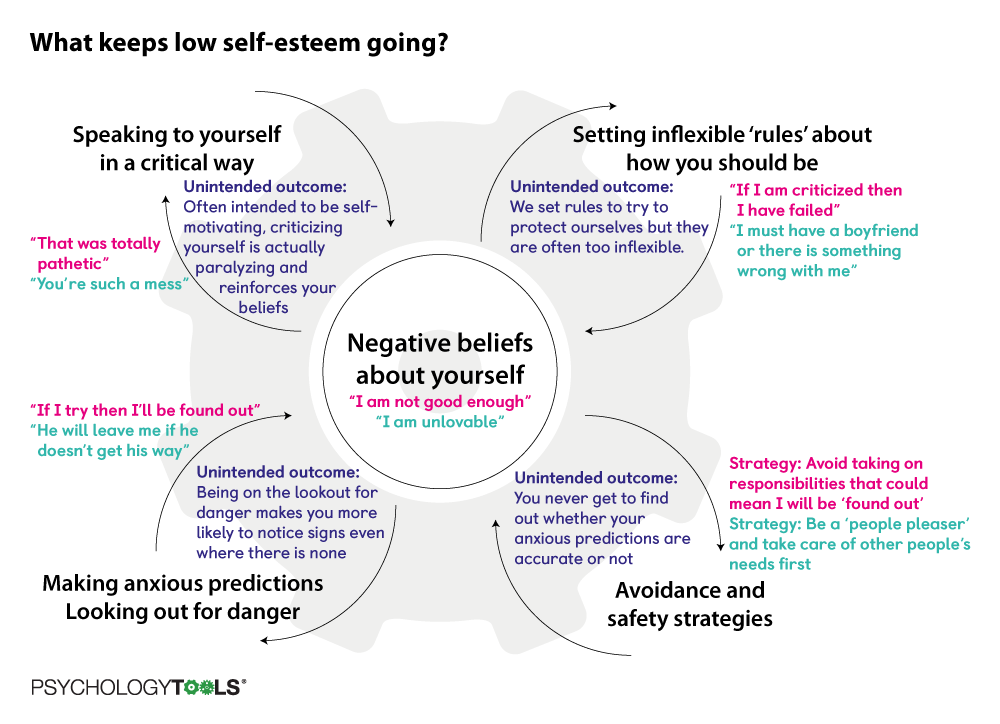
Self-criticism, inflexible rules and standards, anxious predictions, and avoidance can all have a negative impact. PsychologyTools has a great vicious flower diagram of some of these self-perpetuating thought patterns.
Social media use tends to decrease self-esteem (no surprise there). It encourages comparisons that are often unrealistic because so many people are presenting a carefully selected side of themselves.
Low self-esteem is a common issue in various mental disorders, including depression. The grandiosity seen in narcissistic personality disorder is often built on a foundation of negative perceptions of the self, and high esteem is sought from others to compensate. However, finding one’s tribe and accessing peer support can be a good thing, so a lot has to do with how you use it.
Building blocks of self-esteem
Psychologists have identified various ways to boost self-esteem, including:
- setting realistic goals
- not being perfectionistic—of course, easier said than done, but accepting mistakes and imperfections is actually better for your mental wellbeing than striving for perfection
- minimize comparison to others (speaking of easier said than done…)
- being willing to adapt self-image as the self evolves over time (this is an especially important point when it comes to dealing with the effects of chronic illness)
- meditation can help with creating distance from the inner turbulence that’s bound to come up every so often
- using realistic affirmations (unrealistic, rainbows and unicorns-style affirmations can often just make negative appraisals of the self even worse)
- identify and develop your competencies and remind yourself of your achievements
- work on accepting compliments
- practice self-compassion rather than self-criticism
Cognitive behavioural therapy can be useful in reappraising some of the distorted thoughts and thinking patterns that can feed into low self-esteem. Behavioural experiments can help with challenging predictions and addressing avoidance behaviours.
Other things I can see being helpful are being able to laugh at yourself, being able to compartmentalize so poor performance in one area doesn’t spill over into how you perceive yourself in other areas, looking for external factors that may have attributed to outcomes (rather than attributing negative outcomes entirely to your own characteristics).
Implications of Level of self-esteem
Self-esteem can influence how we attribute positive or negative outcomes. Someone who views themselves positively is more likely to attribute positive outcomes to them having done things well, while negative outcomes tend to be attributed, at least in part, to external factors. For someone who views themselves negatively, positive outcomes are more likely to be attributed externally, while negative outcomes are attributed internally.
In adolescents, higher self-esteem has been linked to boys having more confidence to initiate sex and girls having more confidence to set boundaries around sex. Self-esteem, body image, and eating disorder risk are often tied up in a big messy knot in adolescent girls.
People with healthy self-esteem tend to be less critical of themselves and others, less likely to feel shame and guilt, more resilient, and better able to handle stress, be assertive, and set boundaries effectively in relationships.
If you worry about high self-esteem potentially making you a bad person, that’s unlikely to be the case, as long as there’s balance with some of the other related concepts. Healthy self-esteem and healthy self-doubt can happily coexist and keep you realistic about your strengths and weaknesses (and we all have plenty of both). If it’s paired with high self-importance, that’s more likely to cause interpersonal challenges, but healthy self-esteem and high self-importance don’t really like to hang out together.
Getting personal
I remember the last time I was in hospital, which was after a suicide attempt, one of the psychiatrists was certain that I needed to work on my self-esteem. When I told him that wasn’t an issue, he didn’t believe me, because he didn’t think there would be any other reason for me to attempt suicide. It puzzled me that he couldn’t see that not wanting to live because illness made life too shitty had nothing to do with how I felt about myself. I’m good with myself. I’m rather weird, and I’m far from perfect, but that’s okay. My illness is shitty, but it’s an illness I have, not something that I see as being an indicator of something fundamentally wrong with me.
How is your own self-esteem? Does it ever get tangled up with any of the related by different concepts?
Resources
- Building Your Self-Confidence from Mind Tools
- Improving Self-Esteem workbook from the Centre for Clinical Interventions
- Self-Esteem Self-Help Workbook from Wellbeing Services South Glasgow
- Strategies to Build Healthy Self-Esteem from University of Alberta Mental Health Centre
- The Self Confidence Workbook: A Guide to Overcoming Self-Doubt and Improving Self-Esteem
- TheraPlatform self-esteem worksheets
References
- APA Dictionary of Psychology: Self-esteem
- Ideas.TED.com: 5 ways to build lasting self-esteem
- PositivePsychology.com: What is self-esteem? A psychologist explains | What is self-compassion and what is self-love?
- PsychologyTools: Low self-esteem


The Psychology Corner has an overview of terms covered in the What Is… series, along with a collection of scientifically validated psychological tests.


Ashley L. Peterson
BScPharm BSN MPN
Ashley is a former mental health nurse and pharmacist and the author of four books.