


In this series, I dig a little deeper into the meaning of psychological terms. This week’s term is motivational interviewing.
Motivational interviewing (MI) is a therapeutic communication approach. It’s often used in the field of addictions, but it’s got some very useful tidbits that are more broadly applicable to motivation for any sort of change. It also has some helpful hints on how the way we talk to people can push them towards or away from change.
Change and sustain talk
The fundamental idea is that there is always some ambivalence regarding any potential change that’s being considered. The way you talk to someone about the issue can elicit “change talk”, which comes from the side of their ambivalence that favours change, or it can elicit “sustain talk”, which comes from the anti-change side of their ambivalence. If you can get the other person talking about what’s wrong with sustaining and what might be good about changing, it helps to strengthen their motivation to change. The key is to get them talking about it, rather than you telling what you think.
In a recent post about effective anti-stigma campaigns, I mentioned reactance; if you tell someone what to do, their natural tendency is to resist it. Motivational interviewing uses this same concept, and takes the stance that if you argue that change is good, the other person will naturally take the opposite stance, arguing that change is bad (sustain talk). Avoiding arguing for change can be harder than it sounds; in clinical practice, supervision is important to make sure that the natural “righting reflex” doesn’t sneak its way in.
MI Fundamental principles
Motivational interviewing uses a lot of acronyms for key concepts. The fundamental principles of MI are DARES:
- D-evelop D-iscrepancy: help the person see the discrepancy between where they are now and where they want to be with their lives
- A-void A-rgumentation: if you argue for something, the other person will end up arguing again it
- R-oll with R-esistance: pushing back against the other person’s resistance will only strengthen it
- E-xpress E-mpathy: this includes validating how the other person is feeling
- S-upport S-elf-efficacy: empower the individual to create change themselves
Use your OARS
OARS are the key communication tools in MI, especially early on in the process.
- O pen-ended questions
- A ffirmations
- R eflection
- S ummaries
What prompts change
A number of different types of catalysts can bring change into the sphere of something to consider right now. These include:
- consciousness raising: increasing knowledge about the problem; information should be provided from a neutral stance rather than trying to be persuasive
- self-reevaluation: considering the self in relation to the problem behaviours
- self-liberation: making a commitment to change or believing in one’s own ability to change
- counterconditioning: substituting alternative coping mechanisms for anxiety that’s related to the problematic behaviour
- stimulus control: avoiding or coming up with a way to counter stimuli that trigger the problem behaviour
- reinforcement management: rewarding positive change
- environmental reevaluation: assessing how problem behaviours affect the personal and physical environment
Tools used in motivational interviewing
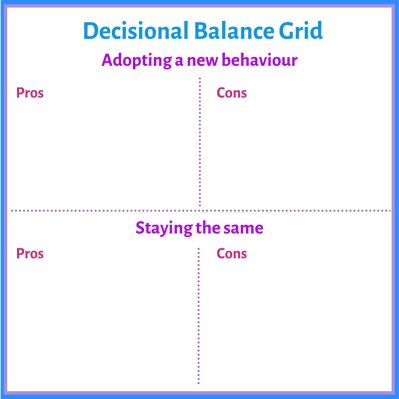
Decisional balance grids are a common MI tool. They help people to lay out pros and cons for both change and maintaining the status quo.

Readiness rulers can be used to rate one’s readiness, willingness, and ability to change on a scale of 1 to 10. Discussions around these tools focus on eliciting change talk. Let’s consider an example where someone marked their ability to change as a 4 out of 10. Asking why they didn’t score higher is likely to elicit sustain talk. On the other hand, asking why they didn’t score lower will probably elicit change talk.


Another strategy is asking about extremes. You might ask the person why the problem hasn’t reached a greater extreme than it already has, so they can identify things that have been working at keeping it somewhat in check. Exploring goals and values can play an important role. Exploring past successes can be a way to enhance a sense of self-efficacy.
MI incorporates the transtheoretical model of change, which includes several stages with respect to making a change: precontemplation (not considering change yet), contemplation, preparation, action, maintenance, and relapse/recurrence. Different strategies are recommended to meet the individual where they’re at in terms of the stages of change.
You can’t make someone change
The whole sneaky idea is to get the person to talk themselves into change. It totally turns the table on our natural inclination to convince people they should make positive change (and of course tell them how we think they should do it). MI frames “resistance” to change as the interviewer (for lack of a better word) pushing too hard; at that point, the interviewer needs to back off and return to using OARS.
If someone is leaning towards the sustain side, the interviewer needs to consider whether that could be, at least in part, a natural reaction to the interviewer pushing the change side of the equation. Your own agenda needs to be checked at the door.
Is there a situation where you think some of these tactics might have been helpful in dealing with another person’s problematic behaviours?
References
- Motivational Interviewing Network of Trainers: Motivational interviewing resources
- Substance Abuse and Mental Health Services Administration (SAMHSA): Enhancing Motivation for Change in Substance Abuse Treatment


The Psychology Corner has an overview of terms covered in the What Is… series, along with a collection of scientifically validated psychological tests.


Ashley L. Peterson
BScPharm BSN MPN
Ashley is a former mental health nurse and pharmacist and the author of four books.