


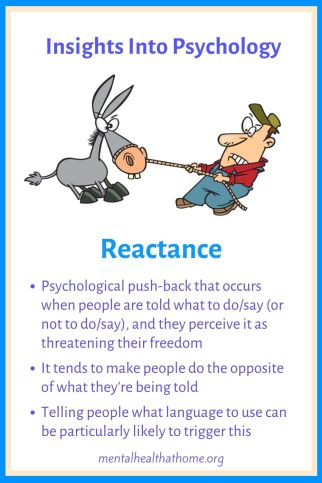
In this series, I dig a little deeper into the meaning of psychology-related terms. This week’s term is reactance.
Reactance was first described by American psychologist Jack Brehm in 1966. Reactance arises in response to having one’s freedoms threatened, such as being told what to do (or not do). It comes into play with “free behaviours”, i.e. behaviours that people think they have a right to have control over, and motivates them to take action to preserve their freedom. The effects can be both behavioural and emotional and may involve anger, hostility, and aggression.
While reactance was initially conceived as a temporary psychological state rather than a consistent trait, with further study, it appears to be a combination of both.
Factors influencing reactance
People are more prone to reactance if they’re stubborn, irritable or emotional, and are less prone if they’re agreeable and compliant. Whether people are from collectivist or individualist cultures can also make a difference. I’m a stubborn moose, so sign me up for Team Reactance.
Factors related to the particular freedom involved also make a difference. The more important the freedom and the greater the perceived threat, the more reactance there is likely to be. The use of freedom-threatening language tends to increase reactance, while choice-promoting language and the use of narratives decrease it.
Messaging along the lines of “not doing behaviour X will result in bad outcome Y” is likely to promote greater reactance than “doing behaviour X will result in good outcome Z.” Reactance is decreased when more than one option is provided and if there is a greater sense of empathy associated with the message.
Reverse psychology
Reverse psychology involves telling someone to do one thing with the aim of getting them to do the opposite. It takes advantage of reactance to what’s suggested. Younger children are most susceptible to reverse psychology, while adults are more likely to recognize it as an attempt at manipulation.
Considering context
Reactance can arise in a variety of different contexts. Refusal to wear a mask during the pandemic may stem from free behaviour beliefs related to what’s worn on the body.
Another context where this can come up is in response to anti-stigma campaigns. Mental illness stigma researcher Patrick Corrigan found that anti-stigma efforts that focused on the language that people should and should not use we actually not effective, and he suggested that reactance is likely a major contributor. There’s more on that in an older post, How Can We Fight Stigma Most Effectively?
Motivational interviewing, which is an approach often used in addictions counselling, takes reactance into account, emphasizing that it’s counterproductive for the counsellor to tell the client what they should do.
A stubborn moose
Autonomy is very important to me, and I don’t like being told what to do. One context where reactance was huge for me was when I was hospitalized. For my third hospitalization, I agreed to go into ER voluntarily. Once there, I was quickly committed under the Mental Health Act. I then immediately applied for a review panel to get myself out of hospital.
The next hospitalization was involuntary from the get-go, and I was seriously pissed off at the treatment team. When they proposed ECT, I told them they’d have to haul me there in restraints. I’m actually pro-ECT and it works well for me, but hell to the no was I going to agree to something they were telling me to do. Because I’m a very stubborn moose. Or mule, but moose are in a better position to do some trampling, so I’ll stick with that.
Do you have a tendency to experience reactance?
References
- Miller, S.G. (2016). How does reverse psychology work? LiveScience.
- Reynolds-Tylus, T. (2019). Psychological reactance and persuasive health communication: a review of the literature. Frontiers in Communication, 4, 56.
- Steindl, C., Jonas, E., Sittenthaler, S., Traut-Mattausch, E., & Greenberg, J. (2015). Understanding psychological reactance: New developments and findings. Zeitschrift fur Psychologie, 223(4), 205–214.
- Wikipedia: Reverse psychology


The Psychology Corner has an overview of terms covered in the What Is… series, along with a collection of scientifically validated psychological tests.


Ashley L. Peterson
BScPharm BSN MPN
Ashley is a former mental health nurse and pharmacist and the author of four books.