


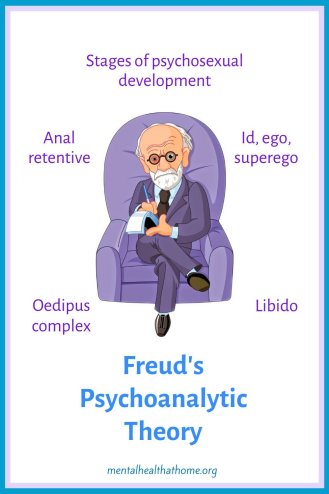
In this series, I dig a little deeper into the meaning of psychology-related terms. This week’s term is not so much a single term as a group of terms that fall within the umbrella of Freud’s psychoanalytic theory.
Love him or hate him, Sigmund Freud was quite remarkable in terms of his impact on the field of psychiatry. In separate posts, I’ve covered various elements of his psychoanalytic theory:
- anal triad
- defense mechanisms
- repression and suppression
- transference/countertransference
- psychodynamic psychotherapy
- is depression anger turned inwards?
This post will consider the ego and the stages of psychosexual development, which served as the basis for his research and clinical work.
Aspects of the mind
Freud saw the mind as consisting of three elements:
- Id: The id is part of the unconscious and is the primal part of the mind focused on seeking pleasure. Consequences are of no matter to the id.
- Ego: The ego is focused on self-preservation, and constrains the id in order to achieve balance between pleasure and pain.
- Superego: The superego develops around the age of 4 or 5. It acts as the conscience, applying moral principles and differentiating right from wrong. Freud divided the superego into two parts, consciousness and the ideal self.
Freud was a great believer in the power of the unconscious. He also believed that nearly everything ties back to sexual drives and comes bursting forth from the unconscious.
Stages of psychosexual development
Freud’s theory of psychosexual development included five stages that humans pass through from birth to adulthood. This was later used as the basis for Erikson’s stages of psychosocial development. The theory considers the way that sexual energy is expressed via the id throughout the developmental stages. People may become fixated at a certain stage and revert to strategies for obtaining pleasure that are consistent with that stage.
The stages are:
- Oral (birth to 1 year old): Pleasure comes through the mouth, from things like sucking and biting. Oral fixation can manifest as things like smoking, nail-biting, or thumb-sucking.
- Anal (1-3 years old): Pooping is pleasure number one in this stage. Potty training is a source of conflict, and can shape how the individual deals with authority in the future. Fixation at this stage can result in people being anal retentive or anal expulsive (disorganized, over-sharing) later in life.
- Phallic (3-6 years old): At this stage, children start to pay attention to their genitals, and they become the primary source of pleasure. Children develop an erotic attraction to the opposite sex parent and become jealous of the other parent. This was part of the Oedipus complex (for boys) and Electra complex (for girls), which also involve castration anxiety on the part of boys and penis envy on the part of girls. This conflict is resolved by the child coming to identify with the same-sex parent.
- Latent (6 years old to puberty): The libido takes a break at this stage to let other kinds of childhood development take place.
- Genital (puberty and onward): In the genital stage, the libido is back and focused on heterosexual intercourse (in Freud’s view this was what constituted normal sexuality that wasn’t affected by fixation or conflict).
Libido
Freud popularized the term libido, describing it as “the energy, regarded as a quantitative magnitude… of those instincts which have to do with all that may be comprised under the word ‘love’.” He considered it to be an innate instinct, much like hunger, that is part of the id.
Libido can be affected by defense mechanisms like repression, pushing it out of conscious awareness, and sublimation, redirecting it into something that’s considered more acceptable.
According to Carl Jung, the libido “denotes a desire or impulse which is unchecked by any kind of authority, moral or otherwise. Libido is appetite in its natural state. From the genetic point of view it is bodily needs like hunger, thirst, sleep, and sex, and emotional states or affects, which constitute the essence of libido.”
The Freud package
While I do think Freud had some interesting ideas, particularly around defense mechanisms, the stages of psychosexual development just don’t do it for me. Sexual drives are obviously important, but the notion that they are behind the transitions we make from infancy to adulthood just doesn’t ring true. Between the ages of 3 and 6 is an important time in terms of social, cognitive, and emotional development, and the way psychoanalytic theory shunts that off to the side and focuses instead on Oedipus and Electra really doesn’t seem useful.
Are you a Freud fan, or does this seem a little out there to you?
References
- Simply Psychology: Freud’s Psychosexual Stages of Development
- Wikipedia: Freud’s Psychoanalytic Theories | Libido


The Psychology Corner has an overview of terms covered in the What Is… series, along with a collection of scientifically validated psychological tests.


Ashley L. Peterson
BScPharm BSN MPN
Ashley is a former mental health nurse and pharmacist and the author of four books.