


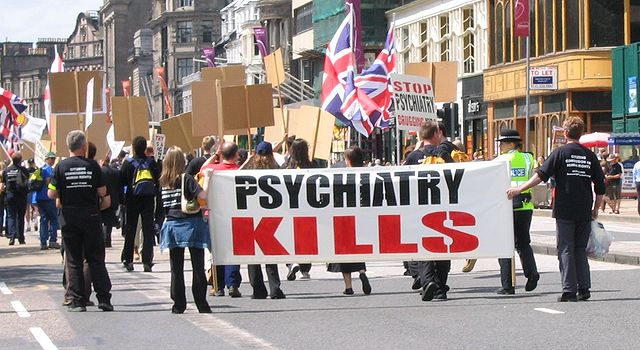
From abuses in asylums to horrific “experiments” in Nazi Germany, the anti-psychiatry movement arose in response to perceived abuses within the mainstream psychiatric establishment. Yet has the movement actually brought about any sort of positive change for those people living with mental illness? Or has it generated more of an academic debate that’s had a minimal impact on the people served by the mental health system?
The term anti-psychiatry appears to have been coined by German doctor Bernhard Beyer in 1912. It became more popular in 1967 with its use by psychiatrist David Cooper. Psychiatrist R.D. Lang was another vocal critic of psychiatry, although he eventually rejected the anti-psychiatry label. He argued that psychosis was not a medical illness but an understandable response to injuries inflicted by schizophrenogenic parents. Well-known philosopher and sociologist Michel Foucault argued that psychiatry, whether inpatient or outpatient, was used primarily for social control. Sociologist Erving Goffman, who did pioneering work on stigma, argued that asylums were “total institutions” that controlled and oppressed those within them.
The role of Thomas Szasz
Psychiatrist Thomas Szasz was a prominent critic of mainstream psychiatry, although he didn’t identify as being part of the anti-psychiatry movement. In his 1961 book Myth of Mental Illness, he argued that what was referred to as “mental illness” was not actually a biological disease, but rather a pattern of behaviour that was viewed by society as problematic. He accused mental hospitals of being more like prisons than hospitals.
Szasz was particularly focused on the role of coercion in psychiatry, likening coerced psychiatric relationships to slavery and rape. He also argued that “suicide prevention is a euphemism for psychiatric coercion.” He added that “To the psychiatrically enlightened, anything connected with death is now a symptom of mental illness.” In The Myth of Mental Illness: 50 Years Later, he wrote:
“Today, the role of the physician as curer of the soul is uncontested. There are no more bad people in the world, there are only mentally ill people.”
In The Therapeutic State, he argued that mental illness was a myth and society viewed psychiatry as useful because it removed unwanted persons from the social milieu. He wrote that Nazi Germany implemented a “therapeutic state”, and psychiatry provided “scientific” justification for mass murder. He wrote that although this was later dismissed as an “abuse of psychiatry”, Nazi and American health ideology actually closely resembled one another, as they were both based on the premise that “the individual is incompetent to protect himself from himself and needs the protection of the paternalistic state”.
Szasz’s opposition to anti-psychiatry
Not only did Szasz not identify as being anti-psychiatry, but he was also openly critical of the movement. In the book Antipsychiatry: Quackery Squared, he wrote that the individuals associated with the anti-psychiatry movement had joined forces with the “therapeutic state” instead of rejecting it, and the movement left an “accursed legacy” of silencing serious criticism of the field of psychiatry.
In Debunking Antipsychiatry: Laing, Law, and Largactil, Szasz expressed his belief that the antipsychiatry movement had actually undermined his own cause. He was openly critical of others who took an antipsychiatry stance. He accused Laing of “psychiatric gobbledygook” and “charlatanry”, and called Cooper, Laing, and Foucault “power-hungry left-wing statists who were interested in taking over psychiatry.”
The Church of Scientology
In 1969, the Church of Scientology established a Citizens Commission on Human Rights, which was co-founded by Thomas Szasz. According to its website, the group “works to expose psychiatric violations of human rights and clean up the field of mental healing.” It accuses the field of psychiatry of “wholesale drugging of children for obscene profits”. The group has established a museum called Psychiatry: An Industry of Death.
In a 1969 article, Scientology founder L. Ron Hubbard claimed that psychiatrists did not actually have any idea how the mind actually worked, and he accused them of hypnotizing politicians. He wrote: “There is not one institutional psychiatrist alive who, by ordinary criminal law, could not be arraigned and convicted of extortion, mayhem and murder.” Chillingly, he went so far as to urge: “We want at least one bad mark on every psychiatrist in England, a murder, an assault, or a rape or more than one.”
Modern anti-psychiatry groups
Aside from Scientology, various organized groups have advocated against psychiatry. One, antipsychiatry.org, specifies that it wants no affiliation with Scientology, and members of the Church of Scientology are not permitted to become members of their organization. MindFreedom‘s stated goal is “a nonviolent revolution in mental health care”, and they oppose “coerced, forced, and fraudulent medical procedures”.
There are also a number of ex-patient groups identifying themselves as psychiatric survivors, including the World Network of Users and Survivors of Psychiatry. The ex-patient organization National Empowerment Center deliberately distances itself from the anti-psychiatry movement, describing it as “largely an intellectual exercise of academics and dissident mental health professionals”.
The University of Toronto in Canada has a scholarship in anti-psychiatry that was established in 2016 by U of T professor Bonnie Burstow to promote anti-psychiatry inquiry. The U of T website states that Burstow’s research group is the “largest single group of anti-psychiatry scholars anywhere in North America.”
Criticism of the anti-psychiatry movement
Controversy persists, and perhaps unsurprisingly, the Wikipedia pages on anti-psychiatry as well as Scientology and Psychiatry have multiple flags for such issues as disputed neutrality, limited worldview, and lack of solid references.
In a pro-psychiatry editorial for Current Psychiatry, Dr. Henry Nasrallah writes that “the original ‘sin’ of psychiatry appears to be locking up and ‘abusing’ mentally ill patients in asylums.” He puts forth lobotomies and labelling homosexuality as a mental disorder as examples of the “perceived misdeeds of psychiatry”. He comments that the anti-psychiatry movement is seen by some as “intellectual halitosis”. This sort of stance minimizing the abusive practices that have been carried out under the guise of psychiatry seems unlikely to provide a strong counterpoint to anti-psychiatry rhetoric.
Conclusion
My biggest question is whether the anti-psychiatry movement has brought about any sort of positive change for those of us with mental illness. If so, I’m not seeing it. Are there problems within the field of psychiatry? Absolutely, but those issues are likely best addressed by narrowing the divide between patient and professional, us and them. The anti-psychiatry movement’s polarizing approach is more likely to shut down dialogue rather than promote it, and this extremist stance actually makes it less likely that the psychiatric establishment will listen to the voices of people dealing with mental illness every day.
Perhaps the most important way to challenge abuses of power that exist within the mental health system is to use our voices. The internet age offers unprecedented opportunities to speak up, and in doing so we are more likely to affect positive change than by trying to fundamentally undercut the very notion of psychiatry and mental illness.
References
- Church of Scientology. (2018). What is the Citizens Commission on Human Rights?
- Dain, N. (1989). Critics and dissenters: Reflections on “anti-psychiatry” in the United States. Journal of the History of Behavioral Sciences, 25, 3-25.
- Hubbard, L.R. (1969). Crime and Psychiatry.
- Nasrallah, H.A. (2011). The anti-psychiatry movement: Who and why. Current Psychiatry, 10(12).
- Ronson, J. (2011). The psychopath test: A journey through the madness industry. New York, NY: Riverhead Books.
- Szasz, T. (2001). The therapeutic state: The tyranny of pharmacracy. The Independent Review, V(4), 485-521.
- Szasz, T. (2008). Debunking antipsychiatry: Laing, law, and Largactil. Current Psychology, 27(2), 79-101.
- Szasz, T. (2009). Antipsychiatry: Quackery squared. Syracuse: Syracuse University Press.
- Szasz, T. (2011). The myth of mental illness: 50 years later. The Psychiatrist, 35, 179-182.
- University of Toronto Ontario Institute for Studies in Education. (2016). Bonnie Burstow scholarship in antipsychiatry.


Making Sense of Psychiatric Diagnosis aims to cut through the misunderstanding and stigma, drawing on the DSM-5 diagnostic criteria and guest narratives to present mental illness as it really is.
It’s available on Amazon and Google Play.