


While we’re used to looking through a Western lens at health and wellness, I think there can be a great deal of value in looking at other ways of understanding to gain new ideas. The medicine wheel is used by certain North American Indigenous peoples to tie together culture, traditional knowledge, health, and healing. Traditionally, it was used in the prairies and plains, but its use has expanded in more recent times. The term “medicine wheel” is modern, but the concept is not.
The image above is from the Anishnaabe people from the Mississauga Nation, in the Canadian province of Ontario. The version below, which isn’t available in a larger size, accompanies the article discussed below.

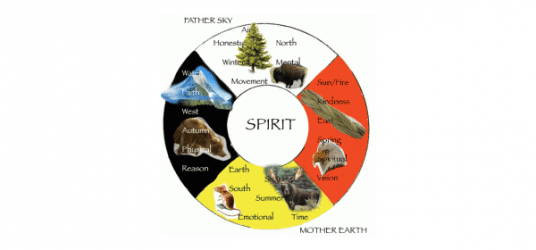
The medicine wheel: an overview
The source of this information is an article by Christina Coolidge, a member of the Tsleil-Waututh First Nation here in British Columbia. In the article, the author explains the teachings she received from her grandmother. This is a very brief overview of that article.
The circle itself is meaningful, as there is no end and no beginning.
The four quadrants represent different peoples—Indigenous, Asian, African and European. Each has its own special knowledge to teach, as well as a gift they possess and an animal that acts as keeper of that gift.
Each quadrant represents a compass direction. For example, East represents the newness and potential for change at the start of the day, and North is about renewal and finding wisdom. While reading Christina’s article, what came to mind was a time for everything, and everything in its time, which Google just told me is a variation of a line from Ecclesiastes.
Each quadrant also represents a season, and the lessons that we can learn about life and transitions from nature’s cycling through each season.
Quadrants also represent sun/fire, earth, air, and water; each is linked to a part of the natural world and the lesson we can learn from it.
Holistic and interconnected
There’s the Goop version of holistic, and then there’s this version. Western notions of health are very individual-focused, but the medicine wheel takes more of an all-encompassing approach to health and wellness. Everything is interconnected, and it doesn’t work to address one part in isolation.
The idea of balance becomes more profound when it’s linked to the processes of the natural world around us. Seeing oneself as part of a much bigger picture could potentially help with feeling less alone, as we all exist within that same bigger picture.
While the biomedical model is good at treating illness, I think there are valuable lessons that can be learned from this kind of holistic view. There’s something to be said for being small in the wholeness of the world we inhabit, and looking to things like trees and mountains for what we can learn from them.
I believe that both a biomedical and holistic view can coexist and be valid. This fits fairly well with my own view that both illness treatment and wellness promotion strategies are needed to manage mental illness; both are important, but neither can replace the other.
What might a holistic view of health look like for you?
Further reading
- Dancing to Eagle Spirit Society, an organization for two-spirited (transgender) individuals
- Teaching by the Medicine Wheel by Anishnaabe scholar Dr. Nicole Bell