


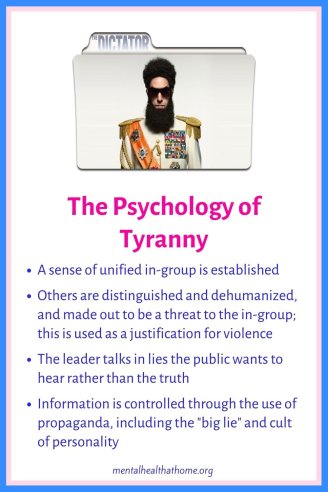
In this series, I dig a little deeper into the meaning of psychology-related terms. This week’s term is the psychology of tyranny.
History is filled with tyrants causing massive damage to humanity. Some of them take power by force, while others, like Adolf Hitler, were chosen by the people. How is it that people are willing to embrace tyrants in the making?
How it starts
Sigmund Freud believed that people who were drawn to authoritarian leaders idealized them, seeing them as heroic and without flaws. Furthermore, he believed people substituted the tyrant for their ego ideal, which represents their guiding values and sense of right and wrong. The leader thus becomes their conscience, and their word determines what’s right and wrong.m There’s a certain parallel to monotheistic religions, where the leader is seen as omniscient, omnipotent, and not to be challenged.
People who follow the leader become part of a collective, with a sense of unity and greater purpose. This is similar to what happens with conspiracy theorists; people are able to unite and feel like they belong and have shared goals.
Speaking of conspiracy theories, othering is an important part of establishing authoritarian regimes. A particular group is identified as conspiring against the in-group, and support of the in-group is rallied to defeat them. mIn the 1920s and 1930s, Fascists created scenarios where conspiratorial “others” necessitated a strong leader to use violence to defeat them. This was likely easy to do given Germany’s crushing reparations they had to pay following World War I.
Authoritarians interact with the public on the basis of lies that the public wants to hear rather than the truth. An article in the Washington Post says:
“Democracy depends upon a certain idea of truth: not the babel of our impulses, but an independent reality visible to all citizens. This must be a goal; it can never fully be achieved. Authoritarianism arises when this goal is openly abandoned, and people conflate the truth with what they want to hear. Then begins a politics of spectacle, where the best liars with the biggest megaphones win.”
Those who join in
Regardless of the personality and mindset of the authoritarian leader, there are many other people who play a supporting role. Not all of them may be psychologically disposed to authoritarianism, but circumstances, role identities, and dehumanizing the “other” can lead to behaviours that might not have been demonstrated otherwise. There were large numbers of concentration camp guards during the Holocaust, not all of whom were monsters to begin with.
The Stanford prison experiment, conducted in 1971 at Stanford University, set up a mock prison with student participants acting as guards or as inmates. The study, which was supposed to last 2 weeks, was terminated after 6 days because the situation had gotten completely out of hand and the “guards” were behaving sadistically and mistreating “prisoners.”
The lead investigator concluded that the study participants had internalized the roles to the point that it overrode their natural personality traits. Deindividuation of the “prisoners” facilitated this. While significant methodological concerns limit the generalizability of the findings, it’s still disturbing to see how quickly average people can take control to extremes.
Research into the psychology of mass violence has shown that sadism can emerge under certain social conditions in people who otherwise do not have sadism as a personality trait.
The propaganda machine
Part of maintaining an authoritarian state is controlling information. Some examples of propaganda strategies that feed into our cognitive biases are:
- appeal to fear: being afraid of the “other” boosts support for the propagandist to take on that other
- big lie: these are “alternative facts,” one might say, that are used to justify subsequent actions; for example, the Nazis crafted the story that Germany only lost World War I because of betrayal by Jews on the home front.
- cult of personality: mass media is used to promote public idealization of an individual
- managing the news: Wikipedia quotes Adolf Hitler as saying “The most brilliant propagandist technique will yield no success unless one fundamental principle is borne in mind constantly – it must confine itself to a few points and repeat them over and over.” —After all, the illusory truth effect shows us that familiarity increases believability.
- name-calling: becomes a substitute for making fact-based arguments
Any of this sounding familiar?
The demise of democracy?
A Freedom House report indicated that, in 2017, 71 countries had an overall decline in political rights and civil liberties. Only 35 had an improvement. This was the 12th year in a row that more countries had declines than improvements.
The Washington Post reports that people who came of age during the internet era are less concerned about democracy and more okay with authoritarianism than any other generation. The article describes the internet erasing the separation between public and private experiences, so we start to think that what’s inside our heads actually represents external reality. Our desires become truth, plenty of bots created by authoritarian regimes will feed us the fiction-as-fact that we want to see.
On Tyranny
In his book On Tyranny (affiliate link), Timothy Snyder warned:
- “Be wary of paramilitaries.”
- “You submit to tyranny when you renounce the difference between what you want to hear and what is actually the case.”
- “The feeling of submission to authority might be comforting, but it is not the same thing as actual safety.”
- “The odd American idea that giving money to political campaigns is free speech means that the very rich have far more speech, and so in effect far more voting power, than other citizens.”
He also pointed out that obeying in advance can cause problems, giving the example of psychologist Stanley Milgram’s experiment in which participants were instructed by the experiment to deliver a series of electric shocks to other individuals. The premise was that these others were involved in a “learning” experiment, and when they gave wrong answers, the experimenter would indicate to the participant to deliver a “shock.” The shocks weren’t actually delivered, but the “learner” actors behaved as though they had actually received a painful shock. Study participants continued following instructions to deliver “shocks” until participants feigned death.
Avoiding tyranny before it happens
The Scholars Strategic Network has put together some handy, and only slightly tongue-in-cheek, tips to avoid heading in the direction of tyranny, such as:
- defend public institutions (a free press would be an example)
- beware of any drive for a one-party state
- notice and remove symbols and signs of hate (like swastikas) as you notice them emerging
- seek truth and facts
- investigate for yourself, look things up, read
- be alert to the use of extremist language
It’s really rather scary how sheep-like we are.
References
- Abramowitz, M.J. (2018). Democracy in Crisis. Freedom House.
- Smith, D.L. (2018). Why We Love Tyrants. Aeon.
- Snyder, T. (2018). Fascism Is Back. Blame the Internet. The Washington Post.
- Snyder, T. (2018). Twenty Lessons on Fighting Tyranny from the Twentieth Century. Scholars Strategy Network.
- Wikipedia: Propaganda techniques


The Psychology Corner has an overview of terms covered in the What Is… series, along with a collection of scientifically validated psychological tests.


Ashley L. Peterson
BScPharm BSN MPN
Ashley is a former mental health nurse and pharmacist and the author of four books.